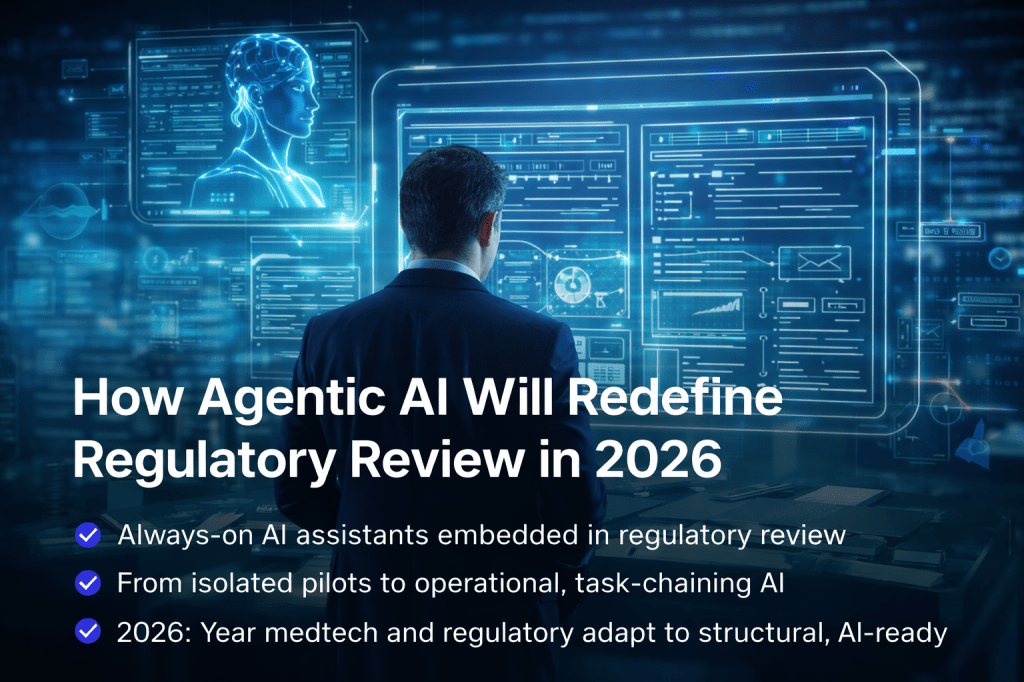
Let’s talk about a quiet but massive shift happening at the FDA. It’s moving from just experimenting with AI to fully embedding it into the heart of how it reviews medical products. For anyone in medtech, 2026 is the year this change becomes real.
Think of it this way: the FDA is moving from having a few handy AI “tools” to building an AI “workforce.” These aren’t just chatbots; they’re persistent, task-oriented assistants designed to handle specific parts of the regulatory review workflow from start to finish.
From Pilots to Partners: The Rise of “Agentic AI”
The groundwork was laid in 2025 when the FDA directed all its medical product centers to adopt a common, secure AI platform. Now, they’re building specialized “agents” on top of it.
A great example is an assistant often referred to as ELSA (e.g., “Evidence and Literature Summarization Assistant”). Imagine ELSA as a super-powered research partner for an FDA reviewer. It can rapidly ingest, summarize, and connect scientific literature and evidence from a submission.
But ELSA isn’t alone. The FDA is fostering this shift internally through initiatives like its Agentic AI Challenge, where its own staff build and showcase these task-focused agents for jobs like label comparison or monitoring post-market safety signals. The message is clear: AI is becoming a core operational layer, not a side project.
What This Actually Means Inside the FDA
The impact is dramatic. In early pilots, AI assistants have compressed some document-heavy review tasks from days down to minutes by automating data extraction and comparison.
Crucially, these agents are force multipliers, not replacements. They handle the repetitive, time-consuming cognitive work—sorting through literature, checking for consistent terminology, cross-referencing guidance documents. This frees up human reviewers to do what they do best: exercise nuanced scientific judgment, assess complex benefit-risk decisions, and engage in deeper dialogue with companies.
Why Medtech Companies Need to Pay Attention
If the FDA is using intelligent agents to review submissions, your preparation needs to evolve. The old model of submitting long, narrative documents and hoping a human reviewer has the bandwidth to piece your story together is becoming outdated.
Structure is now a strategic advantage. Submissions that are built with AI-readiness in mind are easier for systems like ELSA to parse and validate. This means:
- Clear, machine-readable data instead of data buried in PDFs.
- Explicit evidence chains that logically connect your data to your claims.
- Consistent terminology so an AI doesn’t get confused by different terms for the same thing across your documents.
In short, gaps in logic, weak rationales, and inconsistencies are much more likely to be surfaced early and consistently.
A New Skillset for Regulatory Professionals
This shifts the regulatory affairs role from document producer to evidence system designer. The key question becomes: “How will an AI agent interpret and interrogate our submission?”
Key skills for 2026 and beyond will include:
Structuring Narratives: Translating clinical and engineering stories into organized, computable artifacts alongside traditional narratives.
Anticipating AI Queries: Building dossiers that provide explicit, traceable answers to the questions an agent will ask.
Mastering Data Semantics: Ensuring a consistent “story” is told through clear terminology and structure across all documents.
How to Prepare: Building an AI-Ready Foundation
You don’t need to guess the FDA’s exact prompts. Instead, focus on building a robust, AI-friendly regulatory process:
- Standardize: Use consistent templates and structures across all your programs.
- Be Explicit: State your rationales and risk decisions clearly. Don’t bury the lead.
- Define Everything: Use clear metadata, controlled terminology, and strict version control.
- Ensure Traceability: Create a seamless digital thread from initial requirements through testing, clinical data, and into labeling.
These practices aren’t new, but with AI in the loop, they go from “good to have” to “essential.”
Where SE.ai Fits In: Designing for the New Baseline
This is exactly the gap SE.ai is designed to close. It helps medtech teams move from ad-hoc document creation to designing structured, AI-ready submissions from the outset.
With SE.ai, teams can:
- Build explicit, machine-navigable evidence chains so agents like ELSA can accurately understand your logic.
- Detect inconsistencies and weak support pre-submission, fixing issues before an FDA agent flags them.
- Design dossiers that, when processed by AI, present a clear and consistent story.
In other words, SE.ai helps you design for an AI-augmented FDA from the start, putting you ahead of the curve.
The Bottom Line
The FDA’s own data shows AI can turn days of work into minutes. The agency is all-in on scaling this approach with its common platform and specialized agents.
While the core rules aren’t changing, the expectations for speed, clarity, and structure are. For the medtech world, 2026 is the year to stop seeing initiatives like the Agentic AI Challenge and assistants like ELSA as curiosities. They are part of the new baseline.
Adapting early—by building AI-ready submissions and leveraging platforms that understand this shift—will be the key to navigating this new era with greater predictability, efficiency, and success.


 SE.ai
SE.ai 
Leave a comment